
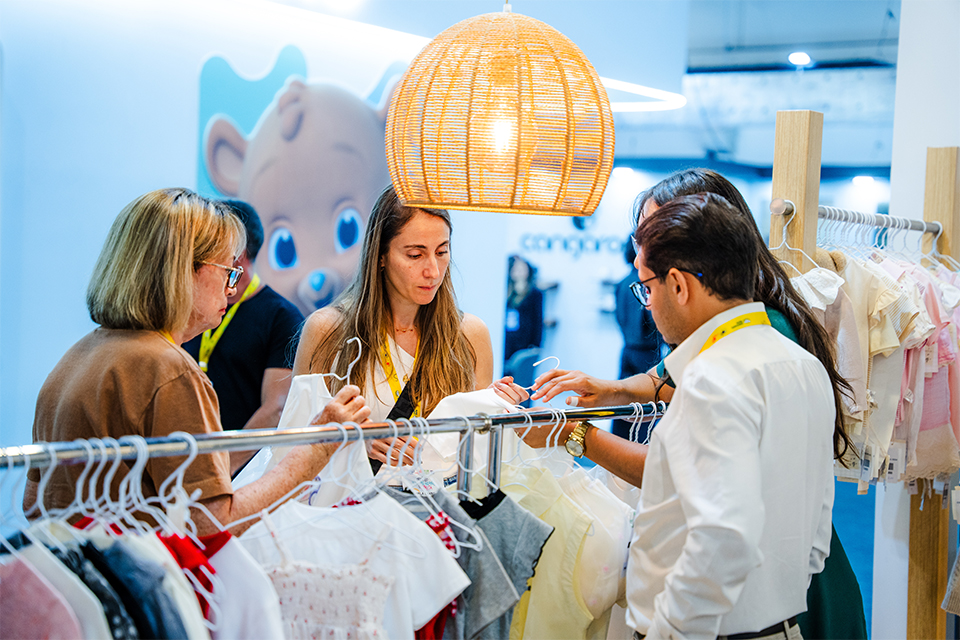
Quick summary: Reaching new retailers in the children’s market requires a combination of digital presence, sales representatives and direct contact. Online channels help catch buyers’ attention, while seeing and experiencing a collection in person can strengthen the business relationship. Major trade shows such as FIT Pueri Expo bring this demand together in one place, giving brands the opportunity to showcase new products, negotiate terms and open new points of sale across Brazil.
Contents
- How can you reach new retailers in the children’s market?
- Before looking for more stores, understand which ones are the right fit
- Where can you find new retailers?
- Making it easier to buy also helps win over retailers
- The first order doesn’t have to be the biggest
- Digital opens doors, but relationships keep distribution growing
- Trade shows create room for new business in the children’s market
- FAQ
How can you reach new retailers in the children’s market?
Having a good children’s product is the starting point for earning space on store shelves. Once a collection, toy or baby care product has been developed, the next step is getting it in front of the people who decide what goes on those shelves and what will ultimately reach consumers.
The market offers room for this expansion. Brazil’s toy market grew by 6% in the first half of 2025, according to Circana. In children’s and baby fashion, production increased by 4% in 2024, while retail sales grew by 5.5%, according to IEMI.
To make the most of this momentum, brands need to look closely at the stores that fit their profile, understand where those retailers are and find effective ways to reach them. Trade shows, sales representatives, digital channels and wholesale hubs can all help connect brands with new buyers.
Before looking for more stores, understand which ones are the right fit
A huge contact list may sound like a great place to start, but numbers alone do not always deliver results. A children’s furniture brand, for example, will have a very different sales dynamic from a company selling clothing, baby bottles, toys or personal care products.
The first step is to build a profile of the retailers that are most aligned with the product. Where are they located? Are they independent stores, chains, e-commerce businesses or specialty retailers? What price range do they work with? Do they already sell similar products? What kind of volume do they usually purchase?
This makes the search more focused and also improves the initial approach. Instead of sending the same generic presentation to hundreds of contacts, the retailer receives a proposal that makes sense for what they already sell and for the customers who shop at their store. With this clearer picture in hand, deciding where to find them becomes much easier.
Where can you find new retailers?
There is no single route to expanding distribution. Some buyers prefer to see products in person, while others discover brands online, work with sales representatives or place orders directly through wholesale platforms.
Using more than one channel usually works better than putting all your efforts into just one. Here is how brands can organize these options:
| Channel | Useful when the brand wants to | What to track |
| Trade shows, such as FIT Pueri Expo | Showcase products and meet new buyers | Contacts that move forward after the event |
| Sales representatives | Take the brand into cities where it still has limited presence | New points of sale by region |
| Wholesale stores and showrooms | Maintain a place where retailers can connect with the brand and purchase products | Return visits and repeat purchases |
| B2B platforms | Make remote ordering easier | Registrations that turn into orders |
| Digital prospecting | Find stores whose profiles are aligned with the products | Responses, contacts and meetings generated |
| Retailer area | Receive retailers who have already shown an interest in selling the brand | New registrations and first orders |
In practice, these channels can also complement one another. A contact made at a trade show, for example, can continue over WhatsApp and eventually turn into an order through a B2B portal.
Making it easier to buy also helps win over retailers
Finding the brand is one thing; retailers also need an easy way to place an order. Some distributors are already using technology to their advantage by developing B2B platforms that bring products from several manufacturers together and simplify purchasing for retailers. With everything in one place, it becomes easier to discover new products, compare options and restock the store.
This matters regardless of company size. An up-to-date catalog, easy-to-find prices and terms, clear minimum order requirements, stock availability and a quick way to speak with someone remove small obstacles that, together, can influence a purchasing decision.
A “Become a Retailer” section on the company website can also help. Interested retailers can register their business, provide company details and request access to wholesale terms without having to search for a contact buried somewhere on the website or social media.
The less effort required between initial interest and the first order, the better.
The first order doesn’t have to be the biggest
For a retailer that does not yet know how well a particular brand will sell, placing a large order means taking on additional risk. That hesitation is understandable.
At this stage, introductory terms can make testing a new brand more comfortable. A manageable minimum order, smaller product assortments, installment payment options or ready-to-ship inventory are some possibilities, as long as they make sense for the company’s operation and margins.
It also helps to give buyers the information they need to understand what they are purchasing. Photos, measurements, display materials, technical information and product pairing suggestions can give them greater confidence when introducing something new to their customers.
Then comes a step that sometimes gets less attention than it should: finding out what happened after those products reached the store.
Asking about sell-through, replenishment and customer response turns after-sales contact into useful information. Over time, the company learns which products perform best for each type of store and can make much more precise replenishment suggestions.
Digital opens doors, but relationships keep distribution growing
Instagram and Google ads, along with a good digital catalog, can put a children’s fashion or product brand on retailers’ radar. Research from Sebrae shows that up to 59% of companies already invest in online advertising. But getting a retailer’s attention is only the first step.
Turning that first click into an order, and eventually repeat business, requires attention to three areas:
- Content that helps at the point of sale: Instead of simply posting attractive product photos, show how those products can work in-store. Children’s window display ideas, product pairing suggestions and simple materials to guide store teams can help them present the products to customers.
- Direct and personalized outreach: Found a store that feels like a good fit for your brand? Keep the approach light. Show that you know the business, introduce your brand in a few words and send the catalog with a simple invitation to talk.
- Local presence through sales representatives: When the goal is to expand into new regions, face-to-face contact still makes a difference. Sales representatives who understand the routines and profiles of stores in a particular city can shorten distances and build long-term relationships based on trust.
Trade shows create room for new business in the children’s market
Some products become much more compelling when buyers can see, touch and try them in person. In the children’s market, this matters even more in categories where finish, fabric, comfort, safety and practicality influence a retailer’s decision.
Trade shows concentrate these opportunities into just a few days. Brands can showcase their latest launches, see buyers’ reactions and understand which products generate the most interest, while connecting their business with retailers from other cities, states and even countries.
As the leading and largest trade show for the children’s sector in Latin America, FIT Pueri Expo is a major meeting point for the industry. Its 2026 edition brought together more than 7,000 visitors from 27 countries and 220 exhibiting brands. The Business Roundtable also brought together 54 major retail chains and multi-brand stores, with an expected R$25 million in business generated.
The next opportunity to be part of this gathering already has a date. From April 6 to 8, 2027, FIT Pueri Expo returns to Distrito Anhembi in São Paulo, bringing together brands, retailers, distributors and buyers from children’s fashion, baby care, toys, footwear, layette, décor and furniture.
For brands looking to reach new retailers, it is an opportunity to put products directly into buyers’ hands, see how collections are received and build partnerships that can continue generating orders long after the three-day event is over.
Want to showcase your products at FIT Pueri Expo 2027?
Click here to learn how to exhibit.
FAQ
How can I find retailers to resell children’s products?
The first step is to define which types of stores are a good fit for the product. From there, buyers can be found through trade shows such as FIT Pueri Expo, wholesale hubs, B2B platforms, social media, online searches and sales representatives.
How should I introduce a children’s brand to a retailer?
A good introduction should make it easy for the retailer to evaluate the business opportunity. Along with showcasing the products, clearly provide information such as wholesale prices, minimum order requirements, availability, delivery times, payment terms and replenishment channels.
Do I need a B2B website to sell to retailers?
Not necessarily. Sales can happen through representatives, WhatsApp, email, trade shows or other channels. Still, having a dedicated retailer area can make it easier for new buyers to register, check commercial terms and place orders.
How can I encourage a retailer to try a new brand?
Reducing the barrier to the first order can help. A manageable minimum order, ready-to-ship inventory, smaller product assortments and sales support materials are some options. Naturally, the terms need to work for the company’s operation and margins.
Can trade shows help brands reach new points of sale?
B2B trade shows bring brands and buyers together in a setting focused on business. At FIT Pueri Expo, for example, the Business Roundtable connects exhibitors with strategic buyers from Brazil and Latin America.
How can a brand expand distribution into other regions of Brazil?
Once the company identifies where demand already exists, it can combine sales representatives, digital B2B sales, distributors and participation in events attended by buyers from other states. Expansion tends to be more sustainable when decisions are supported by order, repeat purchase and regional demand data.